The AI Strategy Problem in Jira and Remedy Data
The AI on your new platform is only as good as the history you feed it. For Jira and Remedy shops, that history is unusually rich, and unusually easy to lose at exactly the wrong moment.
We made the general version of this argument in The AI Strategy Problem Hiding in Your Old ITSM Data. This post is the specific version for the two platforms where the loss tends to hurt most, because of how much meaning lives in their structure.
Why Jira and Remedy history is worth more to AI
Most ITSM platforms accumulate history. Jira and Remedy accumulate structured history, and structure is what AI actually feeds on.
Jira issues carry custom fields, links between issues, workflow transition histories, and long comment threads where the real diagnostic reasoning sits. A model that can read that learns not just what was resolved but how your teams think through a problem.
Remedy, built on the AR System, is metadata-driven to its core. Its forms, relationships, and field definitions encode years of how an organization modeled its own service operations. That is an enormous amount of signal about how your environment behaves, and it is precisely the signal a generic chatbot does not have and your AI is supposed to.
So when this history survives a migration intact, it is one of the most valuable training and grounding assets you own. When it does not, you are deploying AI on a thin recent slice and calling it intelligent.
How the migration strands the most useful data
A migration moves what the business runs on now. Active issues, current workflows, recent records. It is not built to carry a decade of closed, deeply linked history with full fidelity, because that is slow and expensive in direct proportion to how customized the source is. Jira and Remedy are among the most customized systems in the building. That makes them among the most expensive to migrate completely, which makes them among the most likely to get a recent-window migration with the rest left behind.
The left-behind data then goes one of two ways. It stays on the legacy platform, which you keep paying to run. Or it gets flattened to CSV and dropped on a share, losing the links, history, and attachments we covered in Jira CSV export vs. a purpose-built archive. Either way, the richest part of your history is now either trapped or degraded, right as you try to build AI on top of the clean new system that holds none of it.
Bad history does not just fail an audit. It trains the model to be confidently wrong.
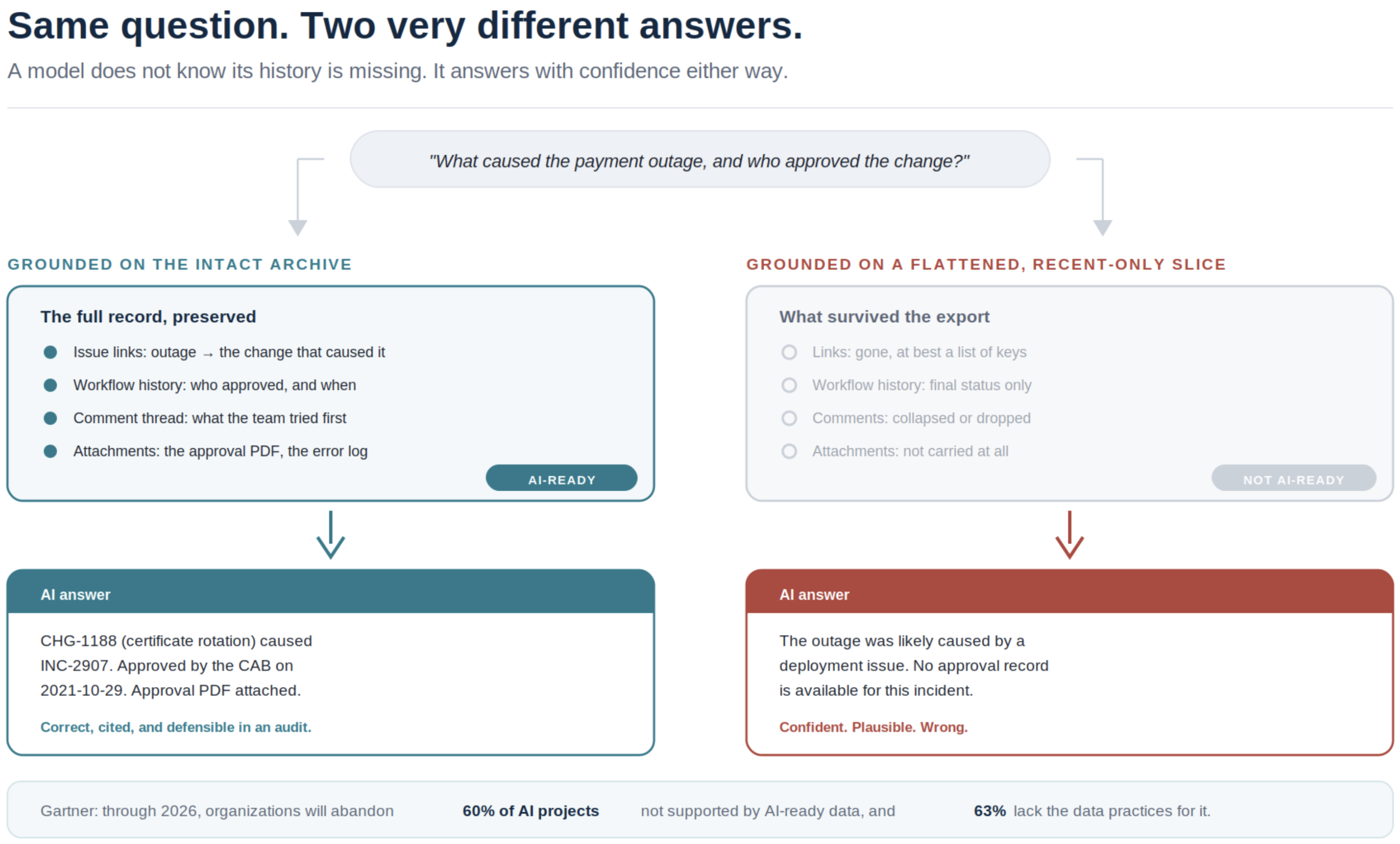
AI grounded on an intact archive answers correctly; AI grounded on a flattened export is confidently wrong.
The model does not know what it is missing. It answers with the same confidence either way.
This is the part that turns a retention problem into an AI problem. Gartner puts numbers on the consequence: it predicts that through 2026, organizations will abandon 60% of AI projects not supported by AI-ready data, and found that 63% of organizations either do not have, or are unsure they have, the right data management practices for AI. A model does not know its training data is partial or degraded. It learns whatever patterns it is given and answers with total confidence. Feed it a flattened, recent-only slice of a Jira or Remedy estate and it will generate answers that sound authoritative and are built on a fraction of the real picture. You are not just failing to find an old record. You are teaching a system to be wrong at scale and to sound sure about it.
The clean new platform makes this easy to miss. Everything looks pristine, because it only holds a few months of activity. The history that would have made the AI genuinely useful is the history that quietly did not make the trip.
Preserve the record, then build on it
The move is the same one we recommend for every platform exit, and it matters more here because the data is worth more. Preserve the full Jira or Remedy historical record intact, in a system you control, before the source goes away. Keep the links, the workflow history, the comments, the attachments, the form structure. Then point whatever you build, compliance search today and AI tomorrow, at a complete record instead of a degraded one.
For Jira Data Center, Cortex Archive does exactly this on its current 3.1.0 release. It preserves the history in its original shape, read-only and on your own infrastructure, with the relationships and context intact, which is precisely the form a model needs and a flat export cannot provide. The 3.1.0 release adds REST API access to archived records and AI-powered search on a bring-your-own-model architecture, so that history can feed the AI you choose instead of sitting in cold storage. You migrate the active estate to Cloud and keep the full record, on your infrastructure, as an asset rather than a liability.
For BMC Remedy, the structural problem is identical, and it is one we are actively building toward rather than one Cortex certifies today. If you are facing a Remedy exit and care about preserving that AR System history for compliance and AI, that is a conversation worth having early, because the metadata-driven structure is exactly what is hardest to reconstruct after the fact and exactly what is most worth keeping.
Deploy the AI. The platforms are good and the capability is real. Just make sure the history that makes it yours is intact and reachable before the old system goes dark, instead of discovering six months in that the model is answering from a shadow of your actual record.
Frequently Asked Questions
Why does ITSM history matter for AI on a new platform?
AI on a new ITSM platform learns from historical tickets: how issues were categorized, resolved, linked, and documented. That history is what makes the AI specific to your environment rather than a generic assistant. If the history is left behind during migration, the model trains on a thin recent slice and loses most of what made it valuable.
Why are Jira and Remedy especially affected?
Both are heavily customized and structured. Jira carries custom fields, issue links, workflow histories, and detailed comment threads. Remedy, built on the AR System, is metadata-driven, encoding years of how an organization modeled its operations. That structure is high-value signal for AI, and it is also the most expensive part to migrate completely, so it is the most likely to be stranded.
Can flattened exports train ITSM AI reliably?
No. Flattening to CSV strips links, workflow history, comment threading, and attachments. A model trained on that learns whatever patterns survive and answers confidently, without knowing the source was degraded. The result is authoritative-sounding answers built on a fraction of the real history.
Is this only a problem at end of life?
End of life makes it urgent, because the source system goes away. But the same gap appears in any migration, forced or chosen. Whenever active work moves to a new platform and historical records are left behind or flattened, the AI you build on the new system starts thin.
Does Cortex support BMC Remedy today?
Cortex Archive supports Jira Data Center, Cherwell, ServiceNow, and Ivanti Neurons. Remedy archival is a direction we are actively building toward, not something Cortex supports today. If you are facing a Remedy exit, the structural problem is the same and worth discussing early, because AR System metadata is hard to reconstruct once the source is gone.
What should I preserve from Jira or Remedy before migrating?
Preserve the full record in original structure: fields, issue or record links, workflow and transition history, comment threads, and attachments, kept searchable like the live system. That is what keeps the history usable for both compliance and AI after the source platform is retired.
Related reading
- The AI Strategy Problem Hiding in Your Old ITSM Data — the general case across all platforms
- How to Archive Jira DC Issues Before a Cloud Migration — preserving Jira history before cutover
- Jira CSV Export vs. Purpose-Built Archive — what flattening drops
- Retire the Platform, Keep the History: Build vs Buy for ITSM Archiving — how to keep history without keeping the platform
The Jira and Remedy history that makes your AI yours is the history most likely to be stranded at migration. Cortex Archive preserves it intact and on your own infrastructure, ready for compliance today and AI tomorrow.